
 Image 1 of 1
You know why your client needs therapy. You understand their diagnosis, current symptoms, and treatment goals. But translating that clinical reasoning into a clear progress note can still leave you staring at a blank documentation box.
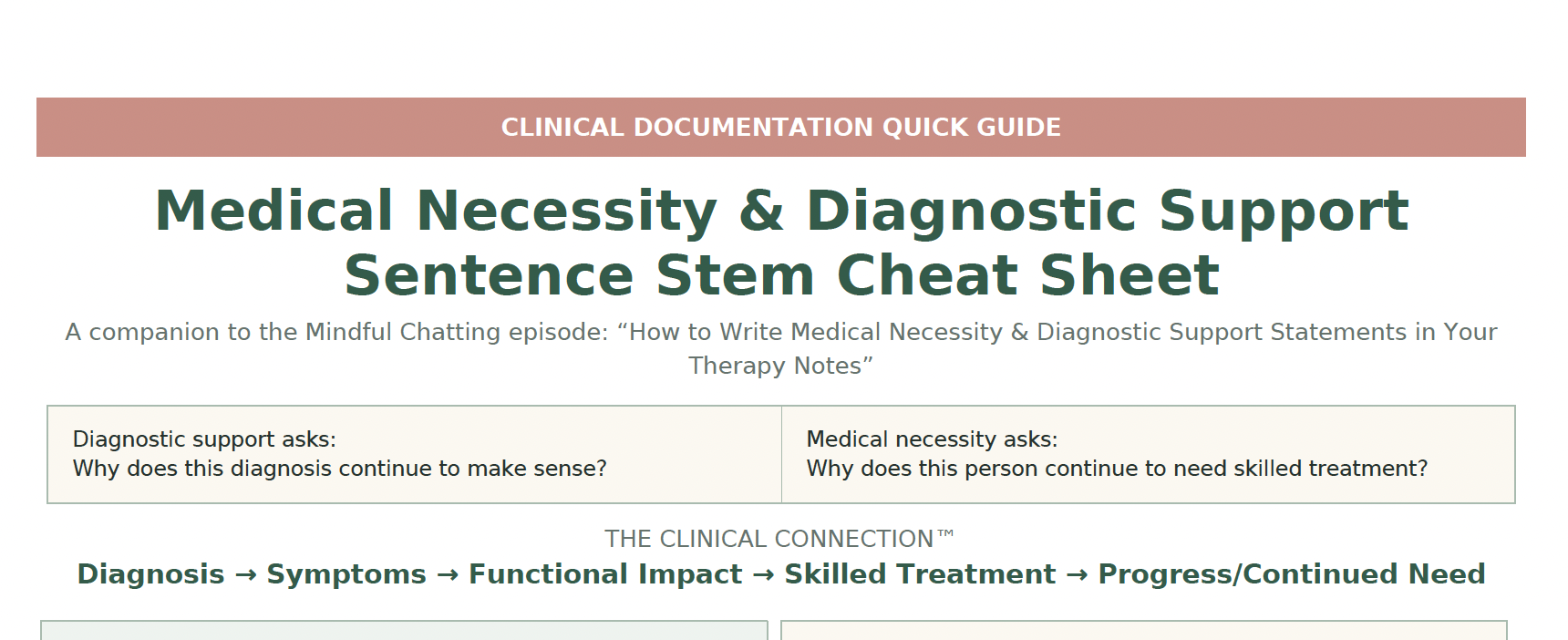
The Medical Necessity & Diagnostic Support Sentence Stem Cheat Sheet is a free two-page clinical documentation guide designed to help therapists write clearer, more individualized progress notes without relying on vague or repetitive statements.
Based on The Clinical Connection™ framework from the Mindful Chatting episode “How to Write Medical Necessity & Diagnostic Support Statements in Your Therapy Notes,” this resource helps you connect:
Diagnosis → Symptoms → Functional Impact → Skilled Treatment → Progress/Continued Need
You’ll receive adaptable sentence starters for documenting:
Current symptoms and diagnostic support
Functional impairment
Skilled therapeutic interventions
Continued need for psychotherapy
Progress alongside remaining clinical needs
Maintenance and stabilization
Reduced treatment frequency and discharge planning
Connections between the session and treatment-plan goals
The guide also includes a 30-Second Note Check to help you answer four essential questions before signing a progress note:
What symptoms or clinical concerns were active?
How are they affecting the client’s functioning?
What skilled intervention did I provide?
Why does continued treatment make sense?
These sentence stems are not generic statements to paste into every client’s chart. They are starting points that help you communicate the clinical reasoning already happening in your head.
Use them to write documentation that reflects the individual client, the services you provided, the client’s progress, and the purpose of continued treatment—without turning every progress note into a novel.
Because good documentation is not necessarily more documentation.
It is more connected documentation.
Therapists and counselors in private practice
Clinical supervisors and supervisees
Associate-level clinicians
Psychologists and social workers
Mental health professionals who struggle with repetitive documentation
Clinicians who want to strengthen the connection between diagnoses, treatment plans, and progress notes
Free two-page digital PDF
Printable or usable as a digital reference
Immediate digital access
No physical product will be shipped
This resource is provided for educational purposes only. The sentence stems are examples and do not represent universal documentation, legal, billing, or insurance requirements.
Clinicians are responsible for adapting their documentation to accurately reflect the individual client, services provided, clinical judgment, applicable laws, licensing requirements, practice setting, organizational policies, and payer contracts.
You know why your client needs therapy. You understand their diagnosis, current symptoms, and treatment goals. But translating that clinical reasoning into a clear progress note can still leave you staring at a blank documentation box.
The Medical Necessity & Diagnostic Support Sentence Stem Cheat Sheet is a free two-page clinical documentation guide designed to help therapists write clearer, more individualized progress notes without relying on vague or repetitive statements.
Based on The Clinical Connection™ framework from the Mindful Chatting episode “How to Write Medical Necessity & Diagnostic Support Statements in Your Therapy Notes,” this resource helps you connect:
Diagnosis → Symptoms → Functional Impact → Skilled Treatment → Progress/Continued Need
You’ll receive adaptable sentence starters for documenting:
Current symptoms and diagnostic support
Functional impairment
Skilled therapeutic interventions
Continued need for psychotherapy
Progress alongside remaining clinical needs
Maintenance and stabilization
Reduced treatment frequency and discharge planning
Connections between the session and treatment-plan goals
The guide also includes a 30-Second Note Check to help you answer four essential questions before signing a progress note:
What symptoms or clinical concerns were active?
How are they affecting the client’s functioning?
What skilled intervention did I provide?
Why does continued treatment make sense?
These sentence stems are not generic statements to paste into every client’s chart. They are starting points that help you communicate the clinical reasoning already happening in your head.
Use them to write documentation that reflects the individual client, the services you provided, the client’s progress, and the purpose of continued treatment—without turning every progress note into a novel.
Because good documentation is not necessarily more documentation.
It is more connected documentation.
Therapists and counselors in private practice
Clinical supervisors and supervisees
Associate-level clinicians
Psychologists and social workers
Mental health professionals who struggle with repetitive documentation
Clinicians who want to strengthen the connection between diagnoses, treatment plans, and progress notes
Free two-page digital PDF
Printable or usable as a digital reference
Immediate digital access
No physical product will be shipped
This resource is provided for educational purposes only. The sentence stems are examples and do not represent universal documentation, legal, billing, or insurance requirements.
Clinicians are responsible for adapting their documentation to accurately reflect the individual client, services provided, clinical judgment, applicable laws, licensing requirements, practice setting, organizational policies, and payer contracts.